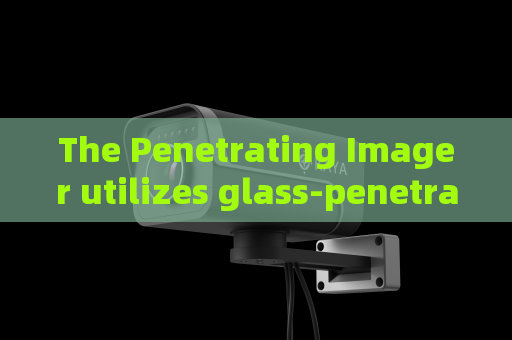
The Penetrating Imager utilizes glass-penetrating imaging to support fixed-point vehicle monitoring at frontier posts At remote frontier posts, fixed-point vehicle monitoring presents a persistent and critical challenge. Guards must inspect every approaching car, truck, or jeep from a standoff distance, often under harsh environmental conditions. Standard optical surveillance systems fail when vehicle windows are heavily tinted, covered with rain, or fogged by temperature differences. Low-light conditions at dawn or dusk further degrade image quality, while bright sunlight reflecting off windshields creates blinding glare that obscures occupants and cargo. These limitations force personnel to either approach dangerously close to unknown vehicles or rely on verbal communication alone, leaving gaps in threat detection. The inability to see through glass reliably means that concealed weapons, contraband, or hostile individuals can pass through checkpoints undetected, undermining the entire purpose of border security. The Penetrating Imager directly addresses this operational void through its advanced through-glass covert observation capability. This system employs laser range-gated imaging technology, a form of active optical sensing that synchronizes a pulsed laser with a gated intensified camera. By emitting short, high-repetition-rate laser pulses and opening the camera’s electronic shutter only when reflected light from the target returns, the device effectively eliminates backscatter from fog, rain, or dirty glass. The result is a crisp, high-contrast image of the vehicle’s interior through the windshield or side windows, regardless of whether they are tinted, wet, or covered with frost. Unlike passive thermal imagers, which cannot penetrate glass, or standard daylight cameras, which are blinded by glare, the Penetrating Imager sees through automotive glazing with clarity. Its ability to operate in zero-light environments, thanks to the laser illumination, ensures that night-time or shadowed vehicles are equally visible. The system’s high resolution allows operators to distinguish facial features, hand gestures, and items on seats or in the footwell from a safe standoff distance. In practice, the Penetrating Imager is deployed as a fixed-position sensor at the checkpoint, mounted on a stable tripod or integrated into a guard tower. An operator monitors a live feed on a ruggedized tablet or screen, using a simple joystick to zoom and fine-tune the image. When a vehicle approaches, the system automatically locks onto the windshield region. Even under heavy rain or thick fog, the glass-penetrating imaging module cuts through the visual noise, delivering a frame-by-frame view of the driver and passengers. The built-in strong light suppression feature handles direct sunlight reflections that would wash out conventional cameras, ensuring that no detail is lost. Guards can perform a tactical visual check through tinted windows without ever stepping out into the open or raising suspicion. If a subject inside the vehicle reaches for a hidden compartment, the operator sees it immediately and can alert the response team. This setup transforms a dangerous “approach and question” procedure into a remote, low-risk identification process, drastically reducing the vulnerability of frontier personnel while increasing the probability of intercepting threats before they cross the border. The same technology also proves invaluable during adverse weather events that would otherwise shut down monitoring. Blowing snow, dust storms, or heavy rainfall scatter visible light so severely that standard cameras become useless. The Penetrating Imager, however, operates on the principle of time-gated laser illumination, which rejects virtually all environmental backscatter. In blizzard conditions, the system maintains clear see-through automotive glass imaging of every vehicle in the queue. This persistence ensures that frontier posts maintain 24/7 vigilance under the most extreme climates. Furthermore, the unit can be integrated with license plate recognition and motion detection algorithms, tying the visual confirmation of occupants to automated alerts. The Penetrating Imager thus becomes the cornerstone of a layered fixed-point monitoring solution, bridging the gap between pure biometric verification and real-world tactical observation through automotive glass. By leveraging glass-penetrating imaging, border security forces gain a decisive advantage: the ability to see inside a vehicle from a distance, through any optical barrier, under any light or weather condition, without compromising safety or covertness.




