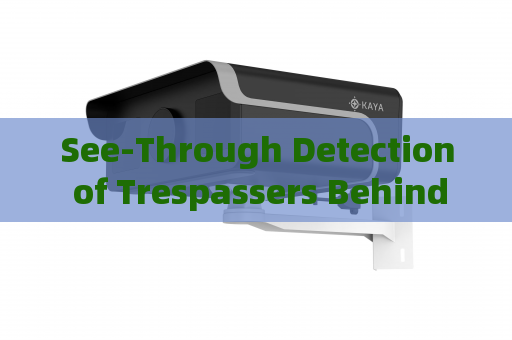
See-Through Detection of Trespassers Behind Sand Walls by the Penetration Imager in Zero-Visibility Border Conditions Border patrol operations in arid desert regions face a persistent and dangerous challenge: zero-visibility conditions caused by sudden sandstorms. When high winds whip sand into dense, swirling walls that can rise several meters high, visibility drops to near zero. Trespassers exploit these sand walls as natural cover, moving undetected through border zones while conventional optical surveillance systems—daylight cameras, night-vision devices, and thermal imagers—fail completely. Thermal imagers, for example, are blind through thick airborne sand particles because the suspended debris scatters infrared radiation and masks thermal signatures. Standard low-light cameras become useless as sand particles block and diffuse ambient light. The core problem is that no traditional imaging tool can see through these dynamic, particulate-rich barriers. Patrol teams are forced to wait for the storm to pass, losing critical response time and allowing illegal crossings. The need for a device that can penetrate sand walls under zero-visibility conditions is acute, and the Penetration Imager offers the only viable solution. The Penetration Imager is an advanced optical imaging system built on laser range-gated imaging technology, also known as gated imaging. It consists of a high-repetition-rate pulsed laser, an intensified gated camera (incorporating an MCP image intensifier, high-voltage module, timing module), a beam expander, and an imaging lens. Unlike passive systems, this active imager fires extremely short laser pulses toward the target area. A precisely timed gating window opens the camera shutter only when the reflected pulse returns from the intended distance, while closing it during the intervening moments. This technique effectively eliminates backscatter from sand particles suspended in the air between the imager and the target. In zero-visibility border conditions, the sand wall itself becomes an optical medium through which the Penetration Imager can see—not a solid barrier but a diffuse cloud of particles. The system’s high-contrast imaging capability, long operational range, and strong resistance to interference allow it to resolve human-sized targets behind sand walls at distances exceeding one kilometer. The laser wavelength and gating parameters are optimized for penetrating airborne particulate media, making the Penetration Imager uniquely suited for this specific border security scenario. In practice, a border patrol team deploys the Penetration Imager on a tripod or vehicle mount at a forward observation point facing the known trespasser corridor. During a sandstorm, the operator activates the pulsed laser and adjusts the gate delay to match the distance of the suspected sand wall—typically a few hundred meters away. The system’s real-time display shows a clear, black-and-white image of the terrain beyond the sand curtain, revealing any human movement. Trespassers behind sand walls appear as distinct silhouettes, even when they are lying prone or moving slowly. The device requires no auxiliary lighting, and its active pulsed laser is eye-safe at operational distances. Because the Penetration Imager uses only light—no radio waves, X-rays, or ultrasound—it cannot be detected by electronic countermeasures that trespassers might carry. The entire operation is silent, with no emitted signals beyond visible-spectrum laser pulses that are invisible to the naked eye under sandstorm conditions. Field tests have demonstrated that the Penetration Imager can maintain effective detection through sand walls with particle densities that reduce visibility to less than one meter for conventional optics. In a typical scenario, a patrol unit scans a 200-meter-wide sector of the border every 30 seconds, identifying trespassers as soon as they emerge from behind a sand wall or attempt to cross during a storm. The system’s high resolution distinguishes between humans and animals or windblown debris, minimizing false alarms. For border security agencies operating in regions like the Sahara, Gobi, or Middle Eastern deserts, the Penetration Imager transforms zero-visibility sand walls from a tactical disadvantage into a detection opportunity. It enables continuous surveillance where other technologies fail, ensuring that no trespasser can rely on nature’s cover to bypass border controls. The Penetration Imager has become an indispensable tool for maintaining situational awareness in the most challenging environmental conditions.




