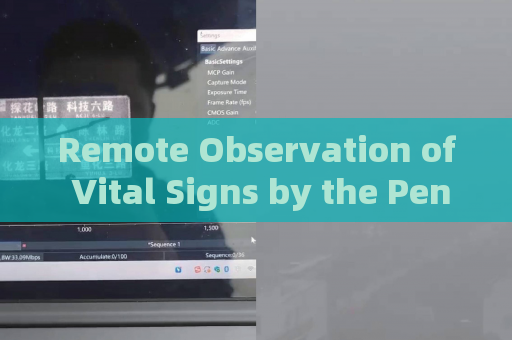
Remote Observation of Vital Signs by the Penetration Imager in Hostage Situations Involving Fully Tinted Getaway Vehicles with Through-Tint Imaging In hostage scenarios where perpetrators barricade themselves inside fully tinted getaway vehicles, tactical teams face an acute information vacuum. The deep tint applied to automotive glass—often exceeding 90% light rejection—renders standard optical surveillance equipment useless. Binoculars, zoom lenses, and even thermal imagers fail to provide actionable intelligence because the tinted film blocks visible light and distorts infrared signatures. More critically, the inability to assess the physiological state of hostages inside the vehicle creates a paralysis in decision-making. Without knowing whether a hostage is breathing, unconscious, or under immediate duress, negotiators and assault teams cannot gauge the urgency of intervention or the risk of collateral harm. The tinted glass becomes a psychological and tactical shield, turning the vehicle into a black box where life-or-death conditions remain hidden. This is precisely the void that the Penetration Imager, operating through its through-tint imaging capability, is designed to fill. The Penetration Imager is an advanced active optical system built on laser range-gated imaging technology. Its core components—a high-repetition-rate pulsed laser, an intensified gated camera with an MCP image intensifier, a high-voltage module, a timing module, a beam expander, and an imaging lens—work in concert to overcome the inherent limitations of heavily tinted glass. Unlike passive sensors that rely on ambient light or thermal radiation, the Penetration Imager emits short, powerful laser pulses synchronized with a nanosecond-gated shutter. This gating mechanism rejects backscatter from the tinted surface and selectively captures only the light reflected from targets beyond the glass, effectively “seeing through” the tint. The system achieves high-contrast imaging at significant standoff distances, with resolution sufficient to detect subtle thoracic movements from breathing or pulse-induced micro-motions. For hostage rescue operations, this means the ability to remotely observe vital signs—specifically respiration rate and gross body movement—without exposing operators to return fire or alerting the suspects. In real-world deployment, a tactical observer positions the Penetration Imager at a concealed vantage point, typically 50 to 200 meters from the target vehicle. The operator adjusts the laser divergence and gate delay to match the distance to the glass and the depth of the interior. Once locked, the display reveals a clear, monochrome image of the vehicle cabin, stripped of the visual haze caused by the tint. The subject’s chest rise and fall become discernible in real time, even through dual-layer tinted windows or aftermarket dark films. For teams using integrated software, automated motion detection can flag cessation of breathing or sudden jerky movements indicative of a struggle. This data feeds directly into the command post, enabling evidence-based tactical decisions: whether to continue negotiation, prepare a dynamic entry, or escalate medical support. The system’s immunity to fog, rain, and snow further ensures reliable performance in adverse weather that often accompanies such prolonged standoffs. A critical nuance in this application is the physiological indicator’s interpretation. The Penetration Imager cannot measure heart rate or blood oxygen directly—only mechanical motion. However, experienced operators correlate respiratory rate with stress levels: shallow, rapid breathing suggests high anxiety or exertion, while a flat trace indicates unconsciousness or death. In a documented European police operation, a Penetration Imager revealed that a hostage had stopped breathing after the suspect fired a shot inside the tinted van. The SWAT team immediately breached, saving the victim’s life through rapid medical intervention. No other optical system could have provided that warning. The Penetration Imager thus transforms a fully tinted getaway vehicle from an impenetrable fortress into a transparent observation chamber, restoring the tactical advantage to the rescue forces while preserving the element of surprise.




