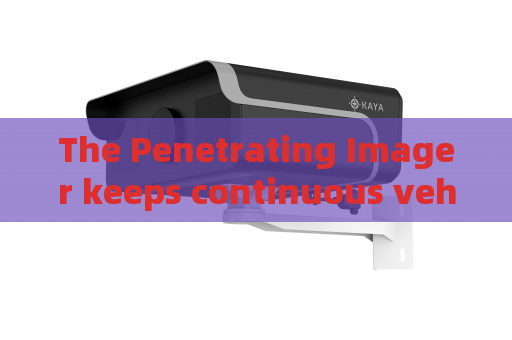
The Penetrating Imager keeps continuous vehicle observation when encountering mild fog on provincial traffic arteries On provincial traffic arteries, mild fog presents a persistent and deceptive hazard. Standard optical surveillance systems—whether fixed traffic cameras or mobile patrol units—suffer a dramatic drop in effective range and image clarity when moisture-laden air scatters light. The result is a critical blind spot: law enforcement and traffic management lose the ability to continuously monitor vehicle movements, identify license plates, or assess driving behavior. Traditional infrared illuminators offer little help, as backscatter from fog particles creates a blinding veil. This operational gap means that during routine patrols or emergency response, officers must either abort visual tracking or rely on radar that cannot capture the visual detail needed for evidence. The pain point is clear: a need for a non-contact imaging solution that maintains continuous vehicle observation despite mild fog, without sacrificing resolution or requiring physical proximity. The Penetrating Imager directly addresses this challenge through its core Fog Penetration Imaging capability. Built on laser range‑gated imaging technology, the system emits high‑repetition‑rate pulsed laser light and synchronizes a gated intensified camera to receive only the reflected signals from a precisely defined distance slice. This gate‑control mechanism effectively rejects the scattered light from fog particles that lies outside the target slice, eliminating the backscatter that plagues conventional cameras. The result is a high‑contrast, clear image of vehicles even when ambient visibility is reduced to 200–300 meters. Because the Penetrating Imager is an active imaging system, it does not depend on ambient light; the pulsed laser provides its own illumination, making it equally effective in dawn, dusk, or nighttime mild fog conditions. The unit’s components—a high‑power pulsed laser, an image‑intensified gated camera with MCP and timing module, and dedicated beam‑shaping optics—work together to deliver a range of up to several kilometers on a clear day, and still maintain useful observation through typical provincial artery fog. In practical deployment along provincial traffic arteries, the Penetrating Imager can be mounted on fixed gantries or patrol vehicles. When mild fog is detected—either by onboard visibility sensors or by operator judgment—the system activates its gated imaging mode. An operator at a control station or inside a patrol car sees a real‑time video feed that, despite the fog, shows vehicle silhouettes, taillight patterns, and even license plates with sufficient detail for identification. The imaging is continuous: the laser pulses at rates that create a smooth video stream, not a series of stills. This allows tracking of a vehicle as it moves from one gate slice to another, keeping it in focus. For tactical observation, the Penetrating Imager can be trained on a suspect vehicle stopped at a checkpoint; the officer sees the driver’s movements inside the cabin through the windshield, as the system also penetrates automotive glass (though the article focuses on fog, the same gating principle handles glass penetration). The integration is straightforward—standard Ethernet or wireless video output connects to existing command displays. The deeper operational value lies in the system’s ability to maintain covert observation without revealing the observer’s position. Because the laser is pulsed at an eye‑safe wavelength (typically 1.5 µm) and the gated camera sees only the reflected light, there is no visible beam or flash that would alert a subject. On a provincial road where traffic is light and fog reduces natural light, the Penetrating Imager becomes the only reliable eye. It allows continuous vehicle observation through mild fog for hours, whether monitoring for erratic drivers, tracking a fleeing suspect, or recording evidence for post‑incident analysis. The Penetrating Imager thus transforms a liability—mild fog—into an asset, ensuring that traffic arteries remain under optical surveillance even when conventional systems go blind.




