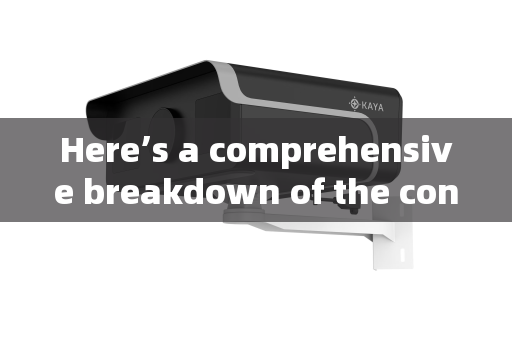
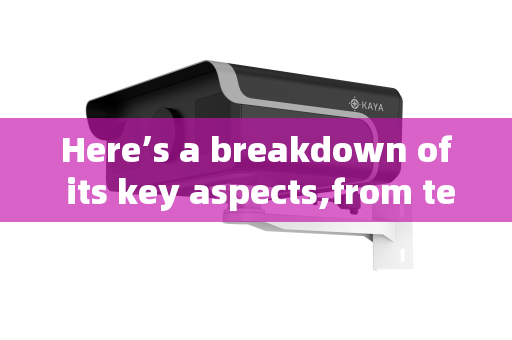
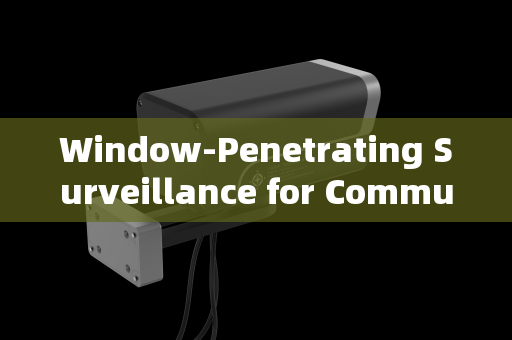
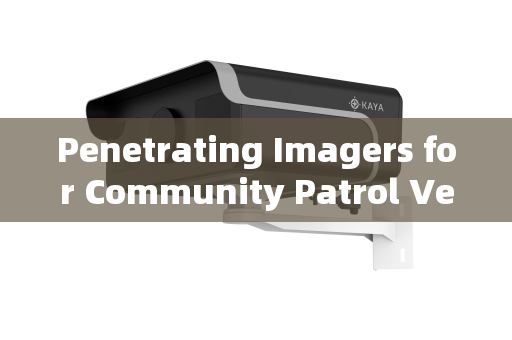
In emergency response, military operations, and security details, visibility is often compromised by dense smoke, fog, haze, or other airborne particulates. Traditional optical and thermal imaging systems struggle in such environments due to significant scattering and absorption of light, which severely degrades image contrast and useful range. Penetration imaging systems, specifically those employing Laser Range-Gated (LRG) Imaging or Gated Imaging Technology, provide a revolutionary solution. This article explains how these advanced systems achieve clear imaging through smoke and other obscurants.
Penetration Imager Effect Images
Understanding the Core Challenge: Scattering
When light from an imaging system illuminates a scene filled with smoke, fog, or dust, photons interact with the suspended particles. A major problem is backscatter: light reflected directly back from the particles toward the camera lens. This backscattered light creates a "veiling glare" or a bright, featureless fog in the image, overwhelming the weaker signal reflected from the actual target behind the obscurant. Conventional continuous-wave illumination and camera systems cannot separate this unwanted near-field backscatter from the desired far-field target return.
The Principle of Time-Discrimination: Gated Imaging
Penetration imaging systems overcome this by exploiting the time-of-flight of light. The core innovation lies in the precise synchronization of a pulsed laser illuminator and a gated, intensifying camera. Here’s the step-by-step process:
-
Pulsed Laser Illumination: The system uses a high-repetition-frequency pulsed laser that emits extremely short, powerful bursts of light (nanosecond duration). This laser light is often in the near-infrared (NIR) or shortwave-infrared (SWIR) spectrum, which penetrates obscurants better than visible light.
-
Precision Timing & "Gating": A highly accurate timing circuit (synchronization module) controls the camera's shutter. This is not a mechanical shutter, but an ultra-fast optical gate (sub-3 nanosecond) within an image intensifier tube. Initially, the camera's gate is closed.
Penetration Imager Effect Images
-
Rejecting Backscatter: As the laser pulse travels, the first light to return to the camera is the backscatter from particles closest to the system (e.g., smoke near the lens). The timing system keeps the camera gate closed during this period, effectively ignoring and rejecting this unwanted signal.
-
Slicing the Scene: After a precise time delay corresponding to the distance to a specific "slice" of the scene, the camera gate opens briefly (for a few nanoseconds). By this time, the laser pulse has traveled to the target slice and back. Only the light reflected from objects within that specific distance range arrives at the camera while the gate is open. Light from other distances is excluded.
-
Stacking for a Complete Image: By rapidly varying the time delay between the laser pulse and the camera gate opening, the system can scan or "slice" through different range intervals. These slices are then computationally stacked to reconstruct a complete, high-contrast image of the scene, free from the obscuring effects of foreground scatter.
System Components for High Performance
A typical high-performance penetration imaging system comprises:
- Pulsed Laser Illuminator: Provides high-power, eye-safe (in many designs), nanosecond pulses.
- Gated Intensified Camera: The heart of the system. It integrates a Microchannel Plate (MCP) image intensifier that provides extreme optical gain (>10^6), a high-voltage power supply, and the critical gate pulse generator capable of picosecond-level timing precision.
- Beam Expander: Widens the laser beam to uniformly illuminate the field of view.
- Imaging Lens: Collects the returning light. Often coupled with narrow-band filters matched to the laser wavelength to further reject ambient noise.
Key Advantages for Emergency and Tactical Applications
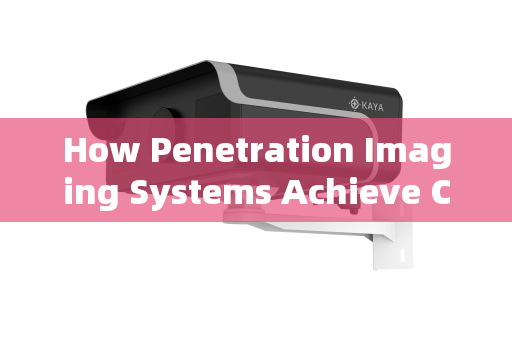
Penetration Imager Effect Images
This technology delivers critical capabilities:
- Suppression of Backscatter: The primary benefit, enabling seeing through smoke, fog, rain, snow, and dust.
- Long Operational Range: Powerful lasers and sensitive detectors allow target detection at distances of kilometers.
- High Range Resolution: The gating principle allows for precise distance measurement to different scene elements, enabling 3D profiling.
- Day/Night & All-Weather Operation: Functions in total darkness and through various atmospheric obstructions.
- Medium Penetration: Capable of imaging through certain transparent barriers like vehicle windows or glass facades with minimal glare.
Application Scenarios
-
Emergency & Fire Service: Revolutionizes urban and wildland firefighting, urban search and rescue (USAR), and mine rescue. It allows firefighters to navigate zero-visibility environments, locate victims, identify hotspots, and assess structural integrity through thick smoke, drastically improving operational efficiency and safety. It is also invaluable for fire training facilities and protecting critical infrastructure.
-
Law Enforcement & Military: Essential for counter-terrorism, covert surveillance, border and perimeter security, maritime interdiction, and tactical assault in obscured conditions. It aids in evidence collection, counter-smuggling operations, and force protection, providing a decisive visual advantage where adversaries rely on obscurants.
-
Coastal & Border Surveillance: Enhances maritime domain awareness by enabling long-range vision through fog and haze. It supports port security, vessel traffic monitoring, search and rescue (SAR) at sea, and naval operations, ensuring continuous surveillance capability in adverse weather.
-
Security & Critical Infrastructure Protection: Used for monitoring high-value assets, pipelines, and borders where weather and environmental conditions are challenging.
In conclusion, penetration imaging systems based on laser range-gating technology achieve imaging through smoke by using time as a filter. By synchronizing nanosecond laser pulses with an equally fast camera shutter, they electronically "cut out" the light scattered by obscurants close to the observer, selectively capturing only the light returned from the target area. This capability makes them an indispensable tool for saving lives in emergencies, ensuring success in tactical missions, and maintaining security in the most visually demanding environments.