In high-stakes emergency response, military operations, and law enforcement scenarios, visibility is the first casualty. Thick smoke, blinding precipitation, and most dramatically, the intense, obscuring curtain of flames create a “white-out” or “black-out” effect for conventional optical and thermal systems. Critical details—a trapped victim, a hidden threat, a structural weakness—are lost. Addressing this challenge, advanced Penetration Imaging Systems (PIS), leveraging cutting-edge Laser Range-Gated Imaging (LRGI) technology, are revolutionizing situational awareness by achieving the seemingly impossible: high-contrast imaging directly through flames.
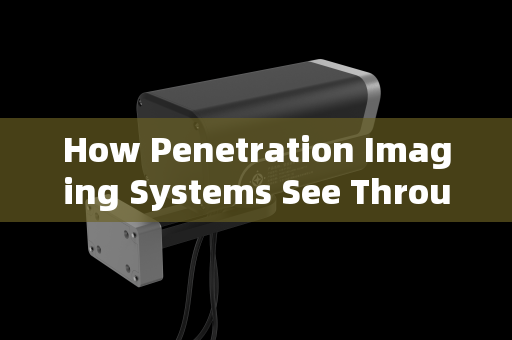
Penetration Imager Effect Images
Demystifying the Core Technology: Laser Range-Gated Imaging
At its heart, a Penetration Imaging System is not merely a camera that “sees through” obstacles. It is an active, time-slicing radar-like optical system. Its core innovation lies in the precise synchronization of a high-repetition-rate pulsed laser and a gated, intensified camera.
The process is a masterclass in temporal precision:
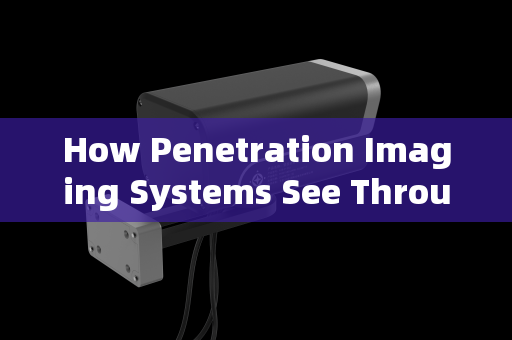
Penetration Imager Effect Images
- Pulsed Illumination: The system emits an ultra-short, high-power pulse of laser light (often in the near-infrared spectrum for better penetration) towards the target scene.
- Gated Reception: The intensified camera remains electronically “closed” (off) during the initial journey of the laser pulse. This is critical. It ignores all the light scattered back from foreground interference like dust, smoke, rain, and the flame front itself.
- Precision Time-Slicing: After a meticulously calculated time delay—corresponding precisely to the time it takes for light to travel to the desired distance slice or “range gate” and back—the camera’s shutter opens for an incredibly brief window (as short as 3 nanoseconds). Only the light reflected from objects within that specific distance slice is captured and intensively amplified.
- Slice Stacking & Imaging: By rapidly sweeping this range gate through the scene and stacking the returning slices, the system reconstructs a clear, high-contrast image of the target behind the obscurant. The intense, but closer, emission from flames is effectively filtered out in the time domain.
System Architecture: Components of a Visionary Tool
A typical PIS comprises:
- Pulsed Laser Illuminator: Provides the structured, time-coded light source.
- Beam Expander: Collimates and shapes the laser beam for uniform scene illumination.
- Imaging Lens: Collects the returning photons.
- Gated, Intensified Camera: The system's core. It incorporates a Microchannel Plate (MCP) image intensifier, delivering optical gains exceeding 10^6, coupled with high-voltage and timing modules. This enables the ultra-fast, nanosecond-scale gating and synchronization with precision better than 10 picoseconds, allowing for high-fidelity 3D data acquisition.
Capabilities and Application Scenarios
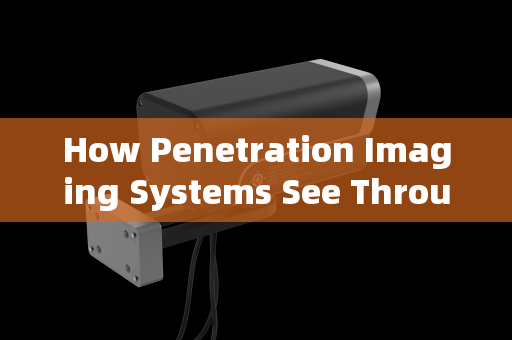
Penetration Imager Effect Images
This technology confers distinct advantages: long imaging ranges, high range resolution, superior resistance to back-scatter and active interference (e.g., glare), and the ability to operate in total darkness.
Emergency & Firefighting Scene:
- Urban & Wildland Firefighting: Enables search and rescue teams to locate persons through flame-filled doorways and windows, identify fire spread paths behind walls of fire, and assess structural integrity. Significantly improves operational efficiency and responder safety.
- Disaster Response (USAR): For mining incidents, building collapses, and industrial accidents where fire is a secondary threat, PIS can peer through smoke and flame to locate survivors.
- Training: Integrated into live-fire training simulators and flagship building security systems for realistic, high-fidelity training and threat assessment.
Law Enforcement & Military Operations:
- Tactical Operations: Provides critical intelligence for counter-terrorism, hostage rescue, and armed intervention by allowing visualization through smoke grenades, fire obstructions, or tinted/windowed vehicle glass (including sedans, buses, and high-speed train windows).
- Surveillance & Reconnaissance: Covertly observe targets through atmospheric obscurants or from behind glass facades and aircraft portholes.
- Border Security & Checkpoint Control: Detects concealed persons in vehicles (overloading, human trafficking) and contraband through various media, day or night.
- Evidence Collection & Forensic Investigation: Can document scenes through residual smoke or challenging environmental conditions.
Coastal & Border Defense, Maritime Security:
- Maritime Domain Awareness: Performs long-range penetration imaging through fog, mist, and sea spray for navigation, ship identification, interdiction operations, and port security, effectively suppressing glint and glare from the water surface.
- Border Surveillance: Maintains continuous watch in adverse weather conditions, ensuring perimeter integrity.
Conclusion
The penetration imaging system represents a paradigm shift in sensor technology. By mastering the dimension of time at the nanoscale, it transcends the limitations of conventional imaging, rendering destructive and obscuring elements like flames temporarily “invisible.” From pulling a victim from a blazing room to intercepting a threat behind fortified glass, its ability to deliver clear visual intelligence under extreme conditions is proving indispensable for first responders, law enforcement agencies, and defense personnel worldwide, forging a new path toward safety and security in the most visually hostile environments.