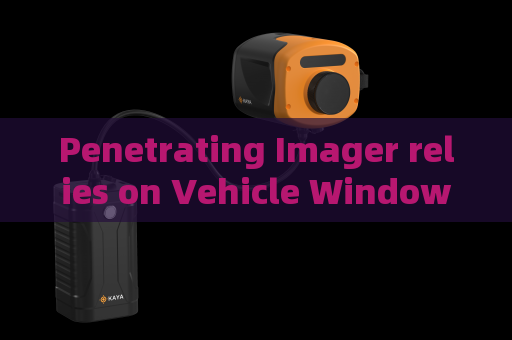
Non-Stop Inspection Capability of the Penetration Imager for Tinted Glass with Strong Light Suppression Imaging at Night Nighttime security checkpoints present a persistent challenge for law enforcement officers. Vehicles with heavy tinted glass, often used to conceal occupants or contraband, become nearly impossible to inspect visually from a safe distance. High‑beam headlights from oncoming traffic, street lamps, and the vehicle’s own interior lights create intense glare that washes out any attempt to see through the windows. Conventional flashlights or spotlights only worsen the problem by reflecting off the glass. Officers are forced to approach the vehicle, exposing themselves to potential threats, or rely on verbal commands that may be ignored. The lack of a non‑stop, continuous inspection capability in these conditions leaves a critical gap in tactical safety and operational efficiency. A solution must not only penetrate the tinted surface but also suppress the blinding light to deliver clear, real‑time imagery without interruption. The Penetration Imager directly addresses this gap through its core laser range‑gated imaging technology. Unlike passive night vision or thermal systems, the Penetration Imager is an active optical instrument that emits high‑repetition‑rate pulsed laser light synchronized with an intensified gated camera. This pulsed illumination, combined with a built‑in microchannel plate (MCP) image intensifier, allows the system to selectively capture photons returning from a specific distance while rejecting scattered light and background glare. When aimed at a tinted car window at night, the laser pulses pass through the glass and illuminate the interior, while the gate timing blocks the reflections from the window surface and any ambient strong light sources. This process enables the Penetration Imager to deliver high‑contrast images of the vehicle cabin even under direct headlight exposure. The system’s ability to operate continuously—switching between frames without mechanical or thermal lag—ensures a non‑stop inspection capability, meaning officers can maintain visual surveillance from a safe standoff distance without gaps in coverage. In practical deployment, the Penetration Imager is typically mounted on a tripod near the checkpoint or integrated into a handheld unit for mobile use. The operator simply points the device at the target vehicle, adjusts the focus and gate delay, and views the interior on a high‑resolution display. Because the system is immune to the backscatter caused by fog, rain, or dust, it works reliably even in adverse weather. For a typical sedan with 20% visible light transmission tint, the imager can reveal occupant movements, hand positions, and objects on seats or the floorboard from over 50 meters away. Officers can scan rows of vehicles in a queue, looking for suspicious behavior without needing to approach each one. The strong light suppression function automatically adapts to sudden changes in ambient illumination—such as a vehicle turning on its high beams—ensuring the image never washes out. This continuous, real‑time feedback transforms the inspection process from a risky close‑contact check into a safe, remote observation task. The operational advantage extends beyond static checkpoints. In highway patrol scenarios, the Penetration Imager can be used from a pursuit vehicle to inspect the target car’s interior while maintaining a safe following distance. The non‑stop capability means officers can monitor the driver’s actions during the entire pursuit, detecting any reaching for a weapon or discarding evidence. The absence of visible light emission—the laser operates in the near‑infrared band—prevents the suspect from knowing they are being observed, preserving tactical surprise. Furthermore, because the system is purely optical and does not rely on any non‑optical detection methods, it remains compliant with legal standards for visual inspection. The Penetration Imager thus provides law enforcement with a decisive tool for overcoming the dual obstacles of tinted glass and strong night‑time glare, ensuring that no vehicle interior remains hidden from a secure vantage point.