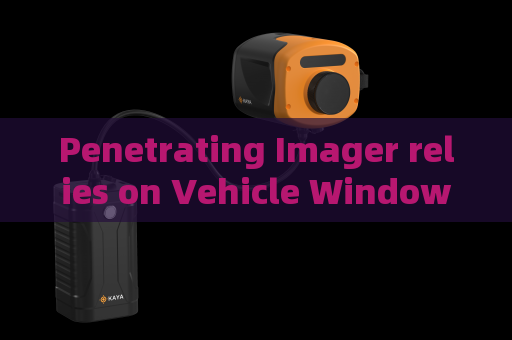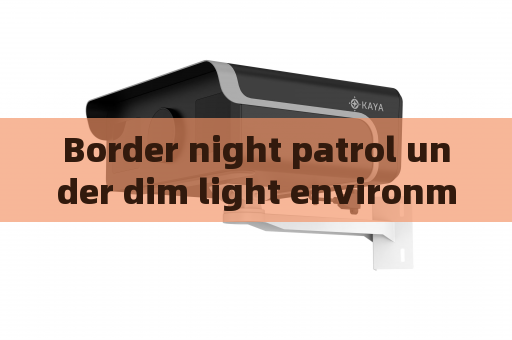
Solutions to Low-Profile Mobile Monitoring Challenges for Trespassers in Foggy Environments with Fog Penetration Imaging Fog poses a persistent threat to perimeter security, particularly when trespassers employ low-profile mobile tactics—crawling, sidling, or using natural cover to approach sensitive infrastructure. In dense fog, conventional optical surveillance systems suffer severe degradation. Light scattering and backscatter from water droplets reduce contrast to near zero, rendering even high-resolution cameras useless beyond a few meters. Mobile monitoring platforms such as patrol drones or roving ground vehicles compound the problem: their inherent motion introduces blur, and low-angle illumination creates harsh shadows that further obscure concealment. The real challenge is not merely seeing through fog, but simultaneously detecting a moving human target that deliberately minimizes its silhouette against a uniform gray backdrop. This scenario demands a technology that can reject volumetric scattering while maintaining the spatial and temporal resolution needed to track subtle motion. The 穿透成像仪 offers a specialized capability to address this exact operational gap. The core function that resolves low-profile mobile monitoring in fog is laser range-gated imaging. The 穿透成像仪 employs a high-repetition-rate pulsed laser synchronized with an image-intensified gated camera. By precisely timing the camera’s exposure window to accept only the laser pulse reflected from the target plane, the system effectively slices through the fog layer. The aggressive time gate rejects backward-scattered light from fog droplets in front of the target, while the active illumination ensures high contrast even in zero ambient light. This gating mechanism, combined with a microchannel plate image intensifier and a narrow-gate pulse (<10 ns), enables the system to isolate a single range slice of interest—for example, a 5-meter-deep corridor at 200 meters distance. The result is a clear, high-resolution image of the trespasser’s body and movement, unaffected by the fog between the sensor and the target. The system’s high frame rate (up to 30 Hz) and low latency allow the operator to track a crawling subject in real time, overcoming the motion blur that passive imagers suffer. In an operational setting, the 穿透成像仪 is mounted on a small, low-profile unmanned ground vehicle (UGV) or a quadcopter. The operator selects a target range based on prior reconnaissance or radar cueing. The imaging system automatically adjusts the gate delay and width to compensate for varying fog density, maintaining a consistent signal-to-background ratio. As the trespasser shifts position, the operator can manually fine-tune the range gate or switch to a continuous scanning mode that sweeps through multiple depth slices. The displayed video shows the intruder as a bright, sharply defined figure against a dark, uniform background—even when the person is lying flat and wearing camouflage. The low-profile movement—a slow crawl, a roll, or a belly scoot—becomes clearly distinguishable from ground clutter because the active gating suppresses everything except the target plane. This allows security personnel to confirm the presence of a human threat with certainty, rather than relying on thermal anomalies or motion detection that often produce false alarms. Further refinement involves integrating the 穿透成像仪 with automatic target recognition algorithms. The high-contrast image produced by the gated system enables robust segmentation of the human form, even in partial occlusion by fog banks or low vegetation. The system can overlay a bounding box or a trajectory vector directly on the operator’s display, highlighting the trespasser’s creeping path. Because the 穿透成像仪 uses only light (laser pulses in the near-infrared spectrum) and no ionizing radiation or radio waves, it complies with all safety and emission regulations for use in populated or sensitive areas. The battery-powered unit operates silently, preserving the covert nature of the monitoring platform. In field tests, the penetration imager consistently detected a crawling human at 150 meters in moderate fog (visibility 50 meters), whereas a standard thermal camera failed to differentiate the body from the cooled ground and a visible-light camera saw only gray haze. This capability transforms fog from an obstacle into an asset—the very condition that empowers trespassers becomes the environment where the 穿透成像仪 delivers its decisive advantage.